Running an overdrive pedal into an acoustic-electric: what actually works
A few years back I was playing a small festival in Asheville — nothing fancy, a stage behind the farmers market on Page Avenue — and the guy before me on the bill ran a battered Telecaster through a Tube Screamer into a tiny Fender combo and absolutely nailed it. Warm, singing, just enough hair on the notes. I remember thinking: could you get somewhere near that on an acoustic? Not the same thing, obviously. But somewhere near.
Turns out you can. It takes some care, and some pedals work considerably better than others, but the idea that overdrive and acoustic guitar are fundamentally incompatible is one of those half-truths that stops players from experimenting.
Why acoustic pickups behave differently than electric pickups
Before you stomp on anything, it helps to understand why the signal coming out of an acoustic-electric is not the same animal as what a Strat or a Les Paul produces.
Most under-saddle piezo systems — the kind built into a huge proportion of acoustic-electrics — output a fairly high-impedance signal with a particular frequency shape: strong presence and high-mids, sometimes a brittle or glassy quality, and very little of the warm low-mid thickness that a magnetic pickup carries. A soundhole magnetic pickup behaves closer to a standard electric humbucker, but piezos are their own thing.
When you push a piezo signal into most distortion and high-gain pedals, the result is thin, fizzy, and unpleasant. That brittleness the piezo already has gets amplified and hardened. The overtone structure of the acoustic body — the part that makes the instrument feel alive — gets swamped rather than enhanced.
Overdrive, dialled carefully, is a different conversation. A low-to-medium gain overdrive adds odd-order harmonics and a gentle compression that can actually smooth out some of the piezo's harsher qualities, if you pick the right circuit and keep the gain modest.
Pedal types to try (and what to skip)
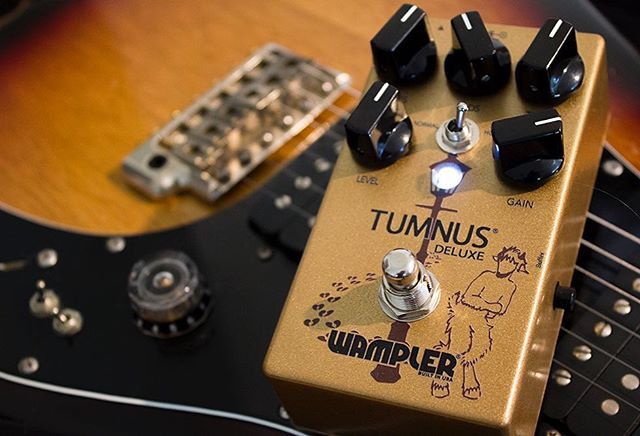
Transparent overdrives tend to behave best. The classic example is a Klon-style circuit — the Wampler Tumnus (check price) is one I've spent a fair bit of time with — because the clean blend in the circuit means you're always hearing the unaffected signal mixed with the driven signal. You get texture without losing the acoustic character underneath. It's a subtle effect but it can genuinely add warmth to a piezo that runs cold.
Tube Screamer-style pedals — the Ibanez TS9 (check price) being the obvious reference point — are worth trying too, but with care. The mid-hump these circuits introduce can clash badly with certain piezo EQ curves, pushing the tone into honky, nasal territory. Back the tone control off significantly, keep the gain low (think 8 or 9 o'clock on the dial), and you might find a setting that adds sustain and body rather than harshness.
Straight distortion pedals — a Boss DS-1 (check price), a RAT — are generally a harder ask. Not impossible, but the higher gain and clipping character tends to erase rather than enhance the acoustic's natural envelope. I'd leave those for electric work unless you're specifically after a wrecked, lo-fi sound as an artistic choice.
Fuzz is a special case. There are players who run Big Muffs into acoustic-electrics and get extraordinary results, but that's a textural effect, not an attempt to preserve the acoustic voice. If that interests you, our fuzz guide covers the circuit differences between gated, sustain-heavy and velcro fuzz — all of which respond very differently to a piezo signal.
The gain control is everything — and most players use too much
This is the thing I'd push back on hardest with acoustic players new to dirt: the amount of gain that sounds good on an acoustic-electric is much lower than you'd think. We're talking barely past unity in some cases. You're not going for a saturated lead tone. You're going for what happens to an acoustic guitar body when it's being pushed just slightly harder than it wants to be — that edge in the attack, that bloom in the sustain.
Set your drive or gain control at 7 or 8 o'clock, then gradually turn it up until you just notice the character of the notes changing. That's your sweet spot. Many overdrive pedals aimed at electric players only really start to show their character at much higher gain settings, which means some circuits simply don't have the resolution at low gain to be useful here. Simpler, cleaner clipping circuits — like a JFET-based overdrive — tend to have more workable range at low settings.
Your amp or PA matters as much as the pedal
Running an acoustic-electric through an overdrive pedal into a guitar amp gives you one result. Running the same signal into a full-range flat-response (FRFR) speaker or a PA gives you a very different one. Guitar amps, even clean ones, colour the signal considerably. They typically have a mid-forward, bass-limited response that can actually complement what a piezo does — though it depends enormously on the amp.
I've had decent results running a Klon-style pedal into a small tube amp on its clean channel at moderate volume, where the amp's own gentle compression adds another layer of warmth. Something in the class of a low-wattage combo — Fender Blues Junior (check price) territory — where the power stage isn't completely stone cold at gigging volume. Running the same pedal into a PA flat is cleaner and more accurate, but sometimes that accuracy reveals everything unflattering about the piezo rather than hiding it.
There's no universal answer. You have to listen in the actual context you're playing in, which means experimenting before the show rather than at it.
Soundhole pickups and contact mics: better candidates than piezo
If overdrive-into-acoustic is something you want to explore seriously, the pickup type matters more than the pedal choice. Soundhole magnetic pickups — from makers like LR Baggs or K&K Sound — produce a warmer, lower-output signal that responds to overdrive much more like an electric pickup does. The dynamic response is better, the frequency curve is friendlier, and you lose less of what's interesting about the acoustic in the process.
Contact microphone systems (K&K Pure Mini is the most common example) are even more representative of the true acoustic sound, but they're also more prone to feedback under gain, so they require careful monitoring and EQ management before you add dirt.
My personal preference, after playing around with this more than I probably should have: a passive soundhole pickup, a transparent low-gain overdrive, and a warm-voiced amp at modest volume. It doesn't sound like an electric guitar and it doesn't sound like an unplugged acoustic. It sounds like something else entirely, and that's not a problem. That's the point.
If you want to see what the overdrive options look like at various price points, our overdrive and distortion buyers guide covers circuits from simple one-knobbers through to more complex transparent drives — worth a read before you spend anything.
Common questions
- Will an overdrive pedal damage my acoustic-electric's pickup or preamp?
- No — provided you're running at normal instrument-level signal strength, an overdrive pedal won't damage a piezo preamp or onboard electronics. The risk is feedback and tonal unpleasantness, not hardware damage.
- Should I run the overdrive before or after my acoustic preamp or DI box?
- For most acoustic-electrics with an onboard preamp, run the pedal after the guitar's output jack, so the signal is already buffered. Running it before a separate DI is generally fine; running it after gives the PA engineer a cleaner signal to work with.
- Why does my acoustic sound fizzy and thin with overdrive but my electric sounds fine?
- Piezo pickups have a high-frequency spike and a different impedance curve to magnetic pickups. That brightness, combined with overdrive clipping, creates fizz. Try cutting treble on the pedal's tone control and using significantly less gain than you would for an electric guitar.
Hey, I'm Doug. I've played the folk circuit for the better part of my life, mostly fingerstyle, and somewhere along the way I started building and repairing acoustics in a little workshop out back. Spend enough time with a sound that comes from wood, air and your bare fingers and you start to hear instruments the way you hear a forest in the morning — alive and full of small details. I'll tell you how a guitar feels under the fingers and how it ages, not just how it photographs.
Folk-circuit fingerstyle player; acoustic builder and repairer
More from Doug
 Electric guitar body woods: what they actually contribute to your toneDo tonewoods really matter on a solid-body electric? Doug breaks down what alder, ash, mahogany and basswood actually do — and what they don't.
- Fuzz pedals with acoustic-electric guitars: what works and what doesn'tRunning a fuzz pedal through an acoustic-electric is tricky. Doug explains what actually works, why most fuzz circuits fight piezo pickups, and how to get useful sounds.
 Acoustic guitar saddle intonation: why your guitar goes sharp up the neckYour acoustic sounds great open but goes sharp past the fifth fret. Doug explains why saddle compensation fixes this — and what to do about it.
- Stacking overdrive pedals: how layering dirt actually worksStacking two overdrive pedals unlocks tones neither can reach alone. Doug explains the signal chain logic, gain staging, and why order matters.
- Fuzz pedals and single-coil guitars: how pickup choice shapes your fuzz toneSingle-coil pickups and fuzz pedals have a complicated relationship. Doug explains what's really going on — and how to get the best from the pairing.
- How fretting-hand pressure affects acoustic tone — and what it tells you about your setupThe amount of pressure you apply when fretting an acoustic note shapes tone more than most players realise — and it points directly to whether your guitar's setup is working for you.