Low-gain overdrive for jazz: pushing an archtop without losing clarity
A student asked me last month why her hollowbody sounded like a different, worse guitar the moment she switched on her overdrive pedal. The chords turned to mud, the bass notes disappeared, and the top end got brittle. She'd bought the pedal because a YouTube demo made it sound lush on a Telecaster. On her ES-175 it did none of that. This is the most common mistake I see jazz players make with gain: treating overdrive as a rock tool and hoping it behaves on an archtop by accident.
It won't, not without adjustment. Low-gain overdrive for jazz is a different discipline entirely, closer to EQ shaping than to "adding dirt." Done right, it thickens a clean tone, adds a bit of harmonic complexity to single-note lines, and gives chord-melody work a touch more sustain without turning your voicings into a wash. Done wrong, it buries exactly the information — the inner voices, the bass movement, the pick attack — that makes jazz phrasing legible in the first place.
Why jazz tone is unusually intolerant of gain
A distorted rock chord works because the ear parses it as one event: a block of sound with a rhythmic edge. A jazz voicing, say a rootless ninth chord or a drop-two triad over a moving bass line, only works if the ear can separate the notes. Overdrive compresses the signal and adds harmonic content that fills the gaps between those notes. Push it too far and a four-note voicing starts reading as noise rather than harmony.
This is also why hollowbody and semi-hollow instruments behave differently under gain than solidbodies. An archtop's top is already doing acoustic work, adding resonance and some natural compression of its own. Stack electronic compression and distortion on top of that and you're compressing twice. I've found full hollowbodies like a Gretsch G2622 Streamliner need noticeably less pedal gain than a semi-hollow or solidbody to arrive at the same perceived "edge."
Where to set the gain knob (and why lower is correct)
My rule of thumb, and I'll admit it's a personal calibration rather than gospel: if you can't still hear which string you picked last within a four-note chord, back the gain off. On most low- to medium-gain pedals that means running the gain control in the bottom quarter of its range, sometimes barely past the pedal's natural "on" threshold.
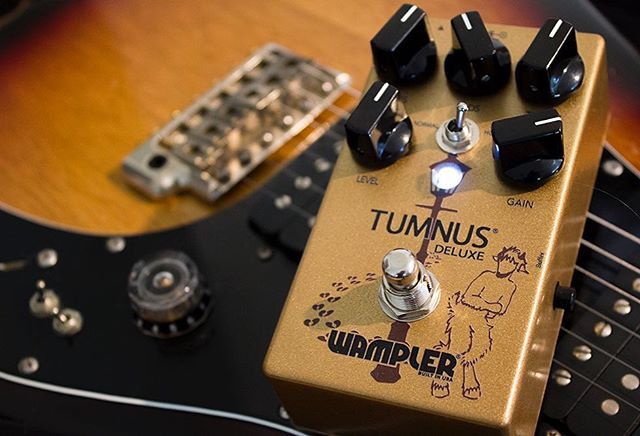
The Boss SD-1 Super Overdrive is a good reference point because its gain range is genuinely usable down near zero, unlike pedals voiced to sound "exciting" only past noon. The Ibanez Tube Screamer TS9 works too, but its midrange hump is aggressive enough that you'll want to compensate elsewhere, more on that below. A Wampler Tumnus, being a transparent-style circuit based on the Klon lineage, is probably the gentlest option of the three for genuinely subtle colour rather than overt drive.
Clipping type matters more here than anywhere else
I wrote at length in our overdrive and distortion pedal guide about how different clipping arrangements change pedal feel, and for jazz this is the single most important spec, more than gain range or even EQ. Asymmetrical clipping, where the two halves of the waveform are clipped unevenly, tends to preserve more of the original note's harmonic shape and reads as "warmer" rather than "fuzzed." Symmetrical clipping compresses both halves evenly and tends to sound more aggressive at the same gain setting.
For chord-melody work I lean toward asymmetrical, tube-like clipping every time. It's gentler on the ear when you're voicing four and five-note chords, and it keeps the top note of a voicing, which usually carries the melody, from getting lost in harmonic clutter generated by the pedal itself.
EQ before gain: taming the midrange
Most overdrive pedals, including the Tube Screamer family, scoop bass and boost upper-midrange by design. That voicing was built for cutting through a rock mix, and it actively works against archtop tone, which already lives in the midrange and depends on low-end warmth for its character. If your pedal has a tone or EQ control, I'd pull it back further than feels natural, and if it has independent bass and treble, nudge the bass up slightly before you touch the gain at all.
The Fulltone OCD is useful here because its two-way voicing switch lets you choose a slightly darker HP/LP filter setting, which suits archtops better than the brighter option most players default to. Set your EQ first, dial gain in second. If you do it the other way round you'll keep chasing a muddy tone with more gain, which only makes the mud worse.
Picking hand and guitar volume do half the work
This is the part most players skip, and it's the part that actually separates good low-gain jazz tone from average. Overdrive pedals respond to input level, and your guitar's volume knob and your picking dynamics are both upstream of the pedal. Rolling your guitar volume back to seven or eight will clean up an overdrive pedal considerably without touching a single control on the floor. Digging in with the pick pushes more gain; playing with a lighter attack, the way you'd comp behind a soloist, keeps things nearly clean even with the pedal engaged.
I've written before about how picking hand technique shapes everything downstream on your board, and nowhere is that truer than with overdrive on a hollowbody. Treat the pedal as a colour you can push into with touch, not a fixed setting you switch on and leave.
Stacking two drives without losing the plot
Stacking is common in blues and rock, less common in jazz, but it has a place. The trick is to use one pedal purely as a clean boost into the front of your amp (low gain, EQ flat or slightly scooped) and the second as the actual drive voice. This mirrors how a lot of session players get a woody, slightly compressed tone for ballad work. I'd avoid stacking two mid-gain pedals of similar voicing; the harmonic content doubles up and you lose definition fast, which is the opposite of what you want on something like a drop-two voicing where the top note needs to ring clearly over the rest.
If you're building a board around this idea, it's worth trying your pedal into a genuinely clean amp platform first before judging it. An amp that's already breaking up slightly will stack unpredictably with pedal gain, and you won't know which stage is doing what to your tone.
None of this is about chasing a sound you've heard on a record. It's about understanding what gain actually does to the information in a chord, and then deciding how much of that information you're willing to trade for colour. Most of the time, less than you think.
Common questions
- Can any overdrive pedal work for jazz, or do I need a specific type?
- Most low- to medium-gain pedals can work if you run the gain low and compensate for midrange boost with EQ. Transparent-style and tube-screamer-style circuits with asymmetrical clipping tend to translate best to archtop tone, but technique and settings matter more than the specific pedal.
- Should I use overdrive on a hollowbody differently than on a solidbody?
- Yes. Hollowbodies already have natural acoustic compression and resonance, so they need noticeably less pedal gain to reach the same perceived edge as a solidbody. Pushing a hollowbody as hard as you would a Stratocaster usually produces unwanted feedback and mud.
- Is it worth stacking two overdrive pedals for jazz tone?
- Occasionally, but treat one as a clean boost and the other as the actual drive voice rather than stacking two similarly voiced drives. Two mid-gain pedals of the same character will double up harmonic content and blur chord definition.
- Why does my overdrive pedal sound muddier on my archtop than it did in a demo video?
- Demo videos are almost always recorded on solidbody guitars through amps already set bright and tight. An archtop's natural midrange and resonance interact differently with a pedal's EQ curve, which is why the same settings can sound muddy on a hollowbody.
I'm Marc. My background is jazz — conservatory training, years of session work, and a long-standing love affair with hollowbody archtops and a clean, articulate tone. I think about gear the way I think about voicings: every component shifts the colour of the whole. I'm drawn to instruments that reward a light touch and reveal what your hands are actually doing. You won't find hyperbole in my reviews; you'll find careful listening, and an honest account of how a guitar or amp behaves when you ask something musical of it.
Conservatory-trained jazz guitarist and session musician
More from Marc
 Miking a cab vs. amp-sim: getting a clean DI tone that sits rightWhy clean archtop and jazz tones often translate better through amp-sims than high-gain does, and how to set levels so your DI tone sits in a mix properly.
- Comping technique: why your left hand shapes your tone more than gearYour comping hand controls voicing clarity, dynamics and tone more than any pedal or amp setting. Here's how I actually practise it.
- Fuzz circuit families explained: Muff, Fuzz Face and Tone BenderA jazz player's guide to the three core fuzz circuit families, what separates their voicings, and why the labels on the pedal matter less than the topology inside.
 Why pickup height changes your touch dynamics more than tonePickup height is usually set for volume or tone balance, but it also shapes string pull and touch response — here's what to listen for.
- Fuzz as a volume-swell effect: using your guitar knob, not the pedalMost fuzz control happens on your guitar, not the pedal face. Here's how rolling the volume knob shapes gain, gate and voicing in real time.
- Fuzz gating on low output pickups: why single coils behave differentlyWhy single coils choke a fuzz pedal differently to humbuckers, and how output, impedance and pick attack shape that gated, sputtering edge.