How overdrive pedals respond to fingerpicking (and why it's different from a pick)
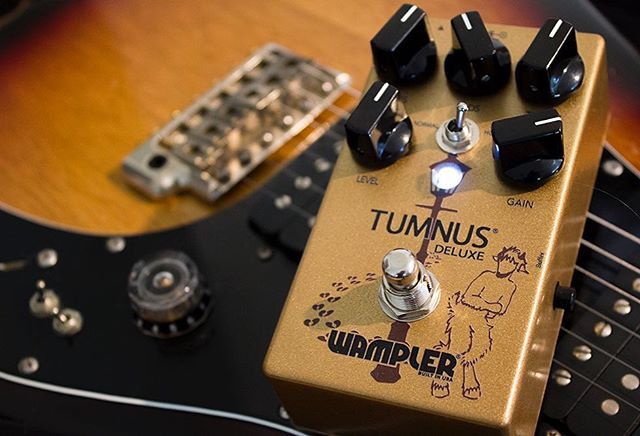
Spend long enough playing fingerstyle on acoustic and then pick up an electric with a dirt pedal, and something feels wrong. The tone you heard in your head — warm, touch-sensitive, just a little fur around the edges — turns into mud on the low strings and a brittle, papery thing up top. The pick player next to you sounds great. You sound like you're wrestling a wet blanket.
It's not you. Or rather, it's not entirely you. Overdrive pedals are designed around a certain kind of attack, and bare fingers aren't it.
Why the attack shape matters so much
A plectrum hits a string with a fast, hard transient — a sharp spike of energy followed by a relatively quick decay. An overdrive or distortion pedal's input stage uses that spike to clip the signal, and the way the clipping settles into the sustained note is a big part of what we hear as "feel."
A fingertip is softer. The flesh gives a little before the string releases, which rounds off that initial transient. The spike is lower and slower. Some pedals love this — they respond with a warmer, more compressed bloom that suits certain styles beautifully. A lot of pedals, though, are voiced to expect that sharp pick attack, and without it they either don't clip in the interesting way they're supposed to, or they sit in an uncomfortable in-between zone: not quite clean, not quite driven.
Thumb technique changes things again. A thumbnail produces an attack closer to a pick, while the pad of the thumb gives you something rounder and lower in output. I've spent years playing with the angle and flesh-to-nail ratio on my right hand, and the difference it makes through a driven amp is honestly bigger than most pedal swaps.
The output level problem
Fingerpickers generally play quieter than flatpickers. Not always, but on average the signal hitting your pedal is weaker. That matters because most overdrive circuits have a threshold — a minimum input level before the clipping becomes musical rather than just noise or thinness.
If you're playing a Tube Screamer-style circuit like the Ibanez TS9 (check price), the clipping is soft and asymmetrical, which means it responds beautifully to dynamics, but it also means a quiet signal sits barely at the edge of the clip region. You'll get that glassy, slightly compressed thing, but the bloom and harmonic richness that makes those pedals special tends to kick in harder when you dig in. Fingerpickers rarely dig in the same way, so you end up sitting on the outskirts of where the pedal actually comes alive.
The fix is often simpler than people think: raise the pedal's gain slightly, lower the tone, and then use your guitar's volume knob to manage headroom. I'll admit I got this wrong for years — I kept the gain modest, assuming I was preserving dynamics, and mostly I was just making the pedal sound thin.
Low-end buildup and string-to-string clarity
Fingerstyle playing often involves independent bass and treble voices running simultaneously. On a clean acoustic that's the whole point — the thumb lays down a bass line while the fingers carry melody. Through a dirt pedal, that simultaneous low and high information tends to conflict. The bass notes saturate the clipping stage and muddy up the midrange, while the treble notes get swallowed or turn harsh.
This is one reason guitarists like Mark Knopfler tended toward very low-gain overdrives or lightly broken-up amps rather than stacked dirt — he needed each string to retain its own character. Hard clipping (think a RAT circuit like the ProCo RAT 2 (check price) with the distortion past noon) compresses all those voices into a single saturated texture. That works for power chords. For fingerstyle independence, it mostly works against you.
My general rule: for fingerpicking, soft-clipping overdrives at low-to-moderate gain beat hard-clipping distortions almost every time. The soft clip rounds things off without destroying the articulation between strings.
Pedals that actually suit fingerstyle playing
Low-gain overdrives with a mid-forward character tend to work best. The Boss SD-1 (check price) is underrated here — the asymmetrical clipping adds a little hair without compressing the dynamics too aggressively. The Fulltone OCD (check price) in HP mode gives you more headroom before clipping, which means softer attacks stay cleaner while harder notes push into breakup; useful if your playing naturally involves both.
What tends to disappoint: any pedal with a hard fixed clipping topology and lots of bass on tap. Thick, scooped distortion that sounds glorious with a heavy pick attack becomes an indistinct wash under fingers. I tried a friend's high-gain setup once at Hazel & Rye, a music café near the Orange Peel in Asheville, and spent the whole session fighting the pedal rather than playing with it.
Using the amp to do some of the work
One approach that genuinely changed how I thought about this: run a clean or lightly set overdrive pedal into an amp that's already sitting at the edge of breakup. The amp's preamp stage adds a softer, more responsive kind of saturation that tracks fingerpicked dynamics much more naturally than a hard-clipping pedal does. A small valve amp set fairly hot — something like the Fender Blues Junior IV (check price) with the volume past six — responds to finger pressure and nail-versus-flesh variations in a way that a pedal into a clean amp rarely does.
The pedal in that scenario becomes a boost and tone-shaper rather than the primary source of drive. That's actually how a lot of classic fingerstyle electric tone was recorded — amp doing the distorting, pedal (if there is one) just pushing the front end a little. If you want to understand the boost approach in more detail, our piece on using an overdrive as a boost goes into the mechanics clearly.
The volume knob is part of your technique
This is something acoustic players often already understand intuitively, because the acoustic doesn't lie — your hands are everything. On electric, the guitar's volume knob extends that conversation into the pedal and amp. Roll back to seven or eight, and a moderate-gain overdrive cleans up into something transparent and articulate. Swell into a note and let the knob come up, and the gain builds as the note sustains.
Fingerpickers, more than flatpickers, have the right-hand independence to develop this kind of control. It's worth spending a session just exploring how volume knob position changes the character of a single overdrive pedal. You'll probably find you need fewer pedals on your board than you thought. I'd say that's genuinely good news, though I know some people prefer to solve problems by adding more gear. No judgement — I've been that person too.
For more on building a pedal setup that's actually usable live, our overdrive and distortion buying guide covers a solid range of options across different circuit types and price points.
Common questions
- Why does my overdrive sound muddy when I fingerpick chords?
- Simultaneous bass and treble strings can overload a clipping circuit's input stage, blurring string-to-string clarity. Try reducing the gain, rolling back the bass on the pedal's EQ, and switching to a soft-clipping overdrive rather than a hard-clipping distortion. A cleaner amp with the pedal as a light boost often gives better string separation than a high-gain pedal into a clean amp.
- Can I use a distortion pedal for fingerstyle, or should I stick to overdrive?
- Overdrive is usually the better choice for fingerstyle work because soft clipping preserves more of the dynamic variation between a gentle pass and a deliberate attack. Hard-clipping distortion pedals compress all that variation into a more uniform saturated texture, which works well for single-note lead lines but tends to flatten the independence between bass and treble voices in fingerstyle playing.
Hey, I'm Doug. I've played the folk circuit for the better part of my life, mostly fingerstyle, and somewhere along the way I started building and repairing acoustics in a little workshop out back. Spend enough time with a sound that comes from wood, air and your bare fingers and you start to hear instruments the way you hear a forest in the morning — alive and full of small details. I'll tell you how a guitar feels under the fingers and how it ages, not just how it photographs.
Folk-circuit fingerstyle player; acoustic builder and repairer
More from Doug
 Ambient delay and reverb settings that actually suit a solo acousticA fingerstyle player's real-world approach to delay and reverb settings on acoustic guitar, without washing out the wood and string detail that made you plug in.
- How often you really need a professional guitar setupDoug breaks down how often an acoustic actually needs a professional setup, and the signs your guitar is asking for one sooner.
 Acoustic pickup types explained: undersaddle, soundhole and body sensorsUndersaddle, soundhole, and body-sensor pickups all colour an acoustic differently. Here's what each one actually does to your tone, from a builder's bench.
- Right hand travel: why less motion means more controlBig right-hand motion feels expressive but costs you accuracy. Here's why trimming travel in your picking or plucking hand changes your tone and timing.
- Micing an acoustic at home: a simple two-mic approach that worksA workshop-tested two-mic setup for recording acoustic guitar at home, without a treated room or expensive gear.
- Recording an acoustic-electric direct: getting a sound that doesn't sound "DI"Piezo pickups sound thin and quacky straight into a DI. Here's how I get a full, room-like acoustic tone without a microphone.