Putting an overdrive before your ambient chain: why gain goes first
Last week I had a student's board on my bench — well, "student" is generous, he's a mate who plays in a shoegaze three-piece down in Bedminster — and he'd put his overdrive after two delays and a reverb because "that's how the pedals were sitting on the board and I didn't want to re-solder the patch cables." Fair enough, honestly, that's a very real reason. But it explained exactly why his big wall-of-sound chorus was turning into a smeared, farty mess the second he leaned on the gain.
This is one of those questions that seems small until you actually plug it in both ways and A/B it, which I do far too often for someone who has actual work to finish. Where an overdrive sits relative to your time-based and ambient effects isn't a minor tweak. It's close to the single biggest decision you'll make about how your board behaves under gain.
Why gain wants to happen before ambience
An overdrive pedal is, at its core, a device that adds harmonic content by clipping the signal — hard or soft depending on the circuit, symmetrical or not depending on the diodes. That clipping process reacts to whatever signal arrives at its input. A clean, single note gets a clean, predictable overdrive tone. A note that's already trailing three repeats of delay and a wash of reverb is not a clean signal anymore — it's a smeared blob of overlapping waveforms, and asking a clipping circuit to make sense of that blob is asking a lot.
Put the overdrive first, and it clips your dry note exactly the way it was designed to. Then the delay and reverb take that already-shaped, already-compressed signal and repeat it, diffuse it, smear it outward. The repeats and the reverb tail have the same harmonic character as your main note, because they're literally made from it. That's the sound most of us are chasing with a wall-of-sound rig: big, harmonically consistent, and — critically — it doesn't turn to mud as soon as two notes overlap.
Reverse it, and every repeat of your delay gets independently smashed against the overdrive's clipping threshold. On a single sustained chord this can sound enormous, genuinely. On anything faster or more chordal, the repeats start intermodulating with each other inside the clipping stage and you get that farty, ring-modulator-adjacent mess my mate was fighting. It's not broken, exactly. It's just a specific, hard-to-control texture that most players stumble into by accident rather than choosing on purpose.
The exception nobody tells beginners about
Here's where it gets properly interesting, and where I'll happily admit the "always put gain first" rule is a starting point, not gospel. If you want a delay or reverb tail that's rougher and more degraded than your dry tone — think shoegaze walls, or the kind of gnarly, saturated ambience My Bloody Valentine or Hum built careers on — putting a fuzz or overdrive after your delay, or in the effects loop after a long reverb, gives you exactly that. The dry note stays relatively clean and articulate, and the tail turns into this chewed-up, harmonically dense cloud behind it. It's a genuinely useful trick. It's just a deliberate choice, not a default.
I've got a boost sitting after my reverb permanently for this reason. It's set low, barely pushing anything on a single note, but the second I hit a big chord and let the reverb bloom, that same boost starts mildly saturating the tail and the whole thing gets thicker without the dry signal changing character at all. Genuinely one of my favourite cheap tricks on the whole board.
Buffers, loading, and why your overdrive might be the problem
There's a wrinkle here that gets ignored constantly: overdrive pedals interact with your guitar's pickups and your amp's input the same way a wah does — via impedance. A true-bypass overdrive sitting early in the chain, switched off, is basically invisible. But switch it on and most overdrives present a different load to whatever's in front of them, which can subtly change your fuzz pedal's behaviour if there's one further up the chain. This is exactly why fuzz circuits are so fussy about what's in front of them — germanium and silicon fuzzes were designed assuming a guitar's pickup was the only thing loading them, and every buffered pedal you add ahead of them changes that assumption.
Practical upshot: if you're running fuzz and overdrive together, fuzz almost always wants to go first, closest to the guitar, with overdrive after it. Overdrives are generally more tolerant of whatever's feeding them. Fuzzes are the diva in the chain.
Stacking two overdrives changes the maths again
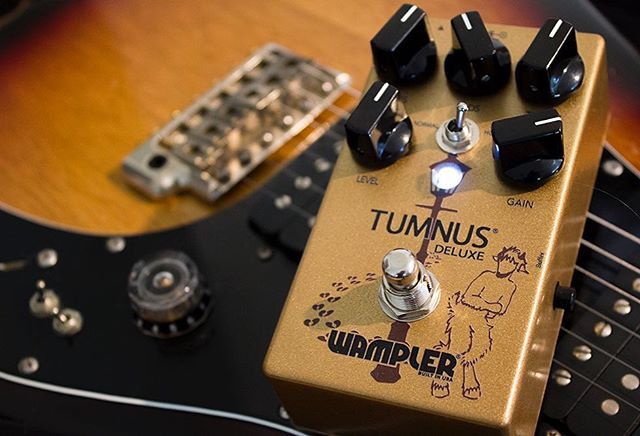
If your board has two gain stages — say a transparent overdrive like the Wampler Tumnus (check price) feeding into something with more grit, like a ProCo RAT 2 (check price) or a Fulltone OCD (check price) — the order between them matters almost as much as where the pair sits relative to your delay. Lower-gain, transparent drive first with its own volume pushing the second pedal's input is the classic "boost into gain" stack, and it tightens up the low end nicely before things get ambient. Get that stacking order sorted before you even think about where the delay goes; two variables at once is how boards turn into science experiments that never quite resolve.
What I'd actually try this week
Put your overdrive at the very front of the chain, straight after any fuzz, before delay and reverb. Play a chord and let it ring into the ambience. Then move the same overdrive to the very end, after everything, and play the same chord. You'll hear the difference inside about four seconds — one version stays coherent as it decays, the other blooms into something wilder and less predictable. Neither is wrong. But you should be choosing it, not backing into it because of how the cables happened to reach.
If you're shopping for the overdrive itself rather than just reordering what you've got, our rundown of the best overdrive and distortion pedals covers the clipping styles worth knowing, and it's worth reading alongside our delay pedal guide if you're building this kind of ambient rig from scratch. Same logic applies to the order of delay and reverb themselves once the gain stage is sorted — it's the same principle, one step further down the chain.
Common questions
- Should overdrive always go before delay and reverb?
- As a default, yes. Clipping a clean dry signal keeps the repeats and reverb tail coherent. But putting a low-gain boost or overdrive after your ambient effects is a deliberate, useful way to get a rougher, more saturated tail while keeping your dry note clean.
- Does pedal order matter more than the pedals themselves?
- For this specific problem, order often matters more than which overdrive you own. A great pedal in the wrong spot in the chain will still sound smeared under delay; a modest pedal in the right spot will behave predictably.
- What if I'm running everything through an effects loop?
- Same principle applies. Gain-based pedals (overdrive, distortion, fuzz) generally belong in front of the amp, in the normal input, while time-based effects go in the loop after the preamp's gain stage. Putting overdrive in the loop after a high-gain preamp is rarely useful.
- Why does my fuzz sound different when I add an overdrive in front of it?
- Fuzz circuits, especially germanium ones, are sensitive to the impedance of whatever's feeding them. A buffered overdrive ahead of a fuzz changes its input loading and can make it sound thinner or more compressed than it does straight off the guitar.
I'm Martin, and I have a problem (it's pedals). I play ambient and post-rock — big washes of reverb, delays into delays, the kind of pedalboard that needs its own roadie — so effects are where I live. I love going down the rabbit hole on a circuit: what's the buffer doing, how does it stack, what happens at the extremes of the knobs nobody dares turn? My reviews tend to wander, because that's how you actually find the magic in a box. I'll always show you the weird, useful corners.
Ambient/post-rock guitarist and lifelong pedal collector
More from Martin
 Why your picking hand decides whether your pedalboard sounds goodYour pedals react to how you pick, not just how you set the knobs. Here's how picking dynamics shape fuzz, delay and reverb response.
- Running an acoustic into ambient pedals without it falling apartWhy ambient pedal chains that sound gorgeous on electric often turn an acoustic-electric to mush, and the signal-chain fixes that actually work.
- Tap tempo technique: getting your delay actually in timeTap tempo looks simple until you're doing it live. Here's how to actually land your delay in time, from foot placement to subdivision traps.
- Preamp pedals on an acoustic-electric: when they help and when they don't
- Running an acoustic-electric into pedals: what actually survives the tripReverb and delay behave differently on an acoustic-electric than on your electric board. Here's what actually holds up, and what falls apart, piezo to pedal.
- Running pedals into an amp-sim: why your board doesn't translate straight to DIWhy your pedalboard sounds different through an amp-sim than a real amp, and how to reorder your chain so it actually translates when recording direct.